CEO Update: 16 million reasons not to wait


America’s youngest voters are getting left in the dust.
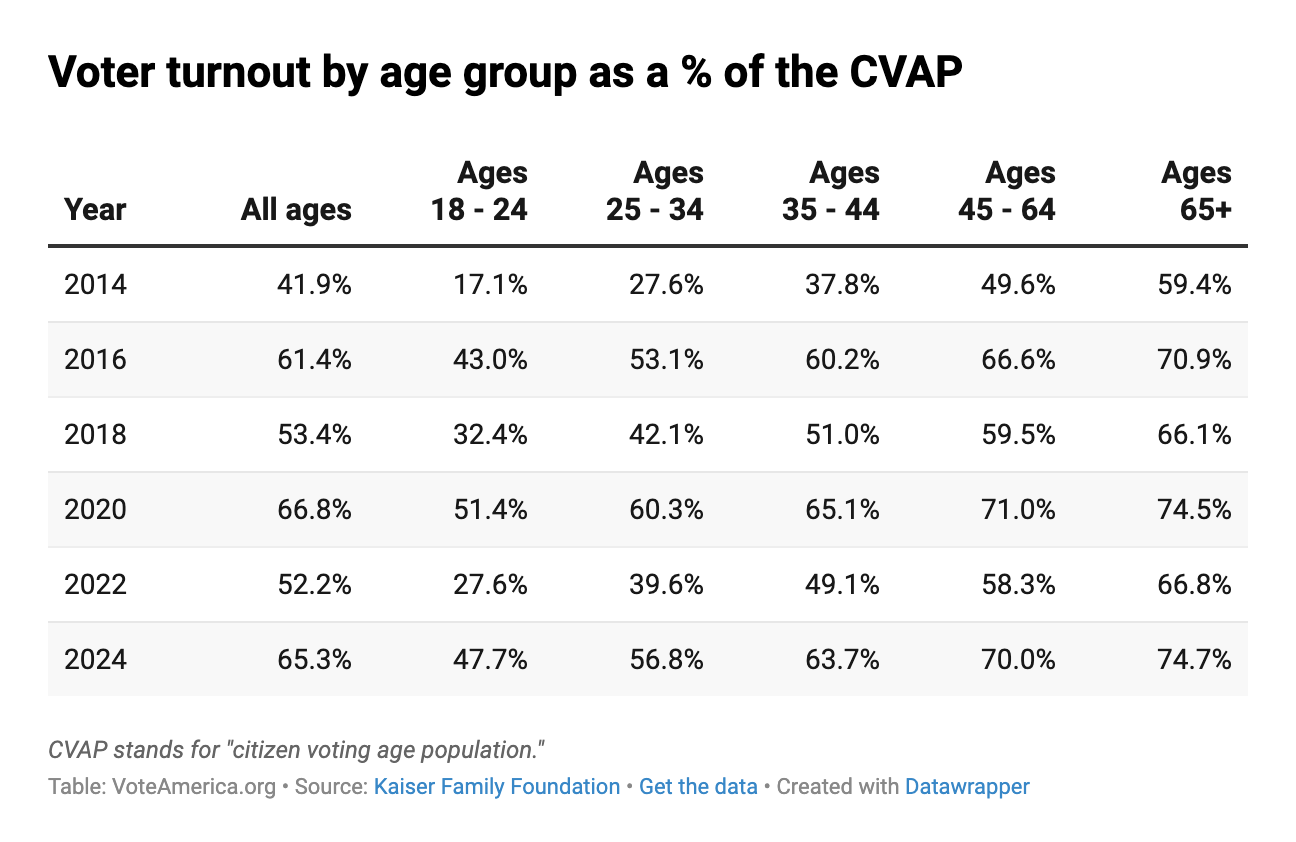
In 2024, turnout among 18- and 19-year-olds was 41%. That’s not just 20 points lower than the 2024 national average (63.7%), it’s also a full 6 points lower than even their slightly older peers, ages 20–29.
And this gap isn’t shrinking, my friends. It’s growing. In 2020, the youngest voters were already trailing the national average by 18 points and their 20-29 year-old peers by 4 points. Now the distance has widened, and we’re just…watching it happen. (Sources: Tufts, CIRCLE; Pew Research Center)
Take a look at this table breaking down voter turnout by age group as a % of the Citizen Voting Age Population (CVAP). (Source: Kaiser Family Foundation)
 |
This is not entirely shocking. When we wait to engage with teens until they are legally eligible to vote, their first exposure to the process happens during the loudest, most polarized, most overwhelming moment in American civic life: the final months of an election cycle.
They’re bombarded with campaign ads, political mailers, text messages from strangers, and nonstop partisan coverage. It’s the noisiest possible environment for someone to take a brand-new civic action. Instead of showing them a clear, simple path to participation, we leave them to navigate it in the middle of a hurricane.
If you want a lifelong voter, this is the worst possible on-ramp. And that on-ramp is very, very important: voting is a habit and, like any habit, it’s easiest to build early.
One of the strongest predictors of lifelong voting is the first age at which someone votes. A young person who casts a ballot in their first three consecutive elections is overwhelmingly likely to become a lifelong voter.
So why are we waiting until they turn 18 to reach them?
There are 16.4 million high schoolers in America right now who will be eligible to vote in the 2028 presidential election. Every single one of them can pre-register before they turn 18.
If this is the first time you’re hearing about pre-registration, you are not alone. I’m the founder of Vote.org for god’s sake and it took me years to figure out.
Put simply, it is a registration form that is kept on file until their 18th birthday, when it automatically activates.
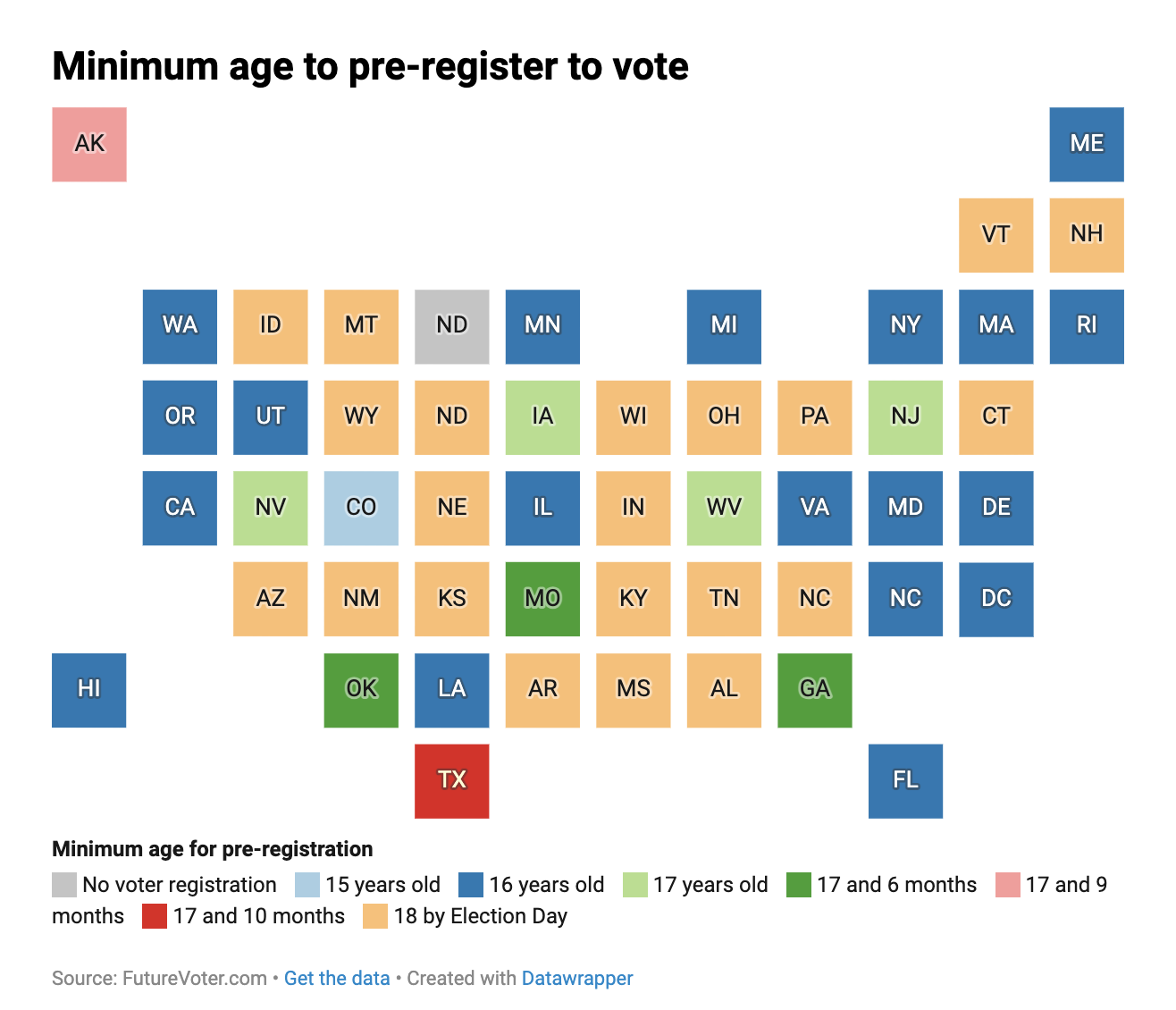
As with most things in voting, the rules vary wildly and unnecessarily by state, but here’s what I want you to imagine: a student pre-registers as a sophomore, forgets about it entirely, and is still ready to vote the moment they turn 18. No extra steps, no missed deadlines.
 |
This is an absolute no-brainer.
And yet, the gap between what’s possible (near-universal pre-registration) and what’s actually happening is stark. The average pre-registration rate is just 12%.
Only four states (Colorado, Maryland, North Carolina, and Utah) get more than 20% of eligible teens pre-registered. Colorado is the standout at 45.8% (Maryland is ~28%, North Carolina ~23%, Utah ~22%). (Source: The Civics Center)
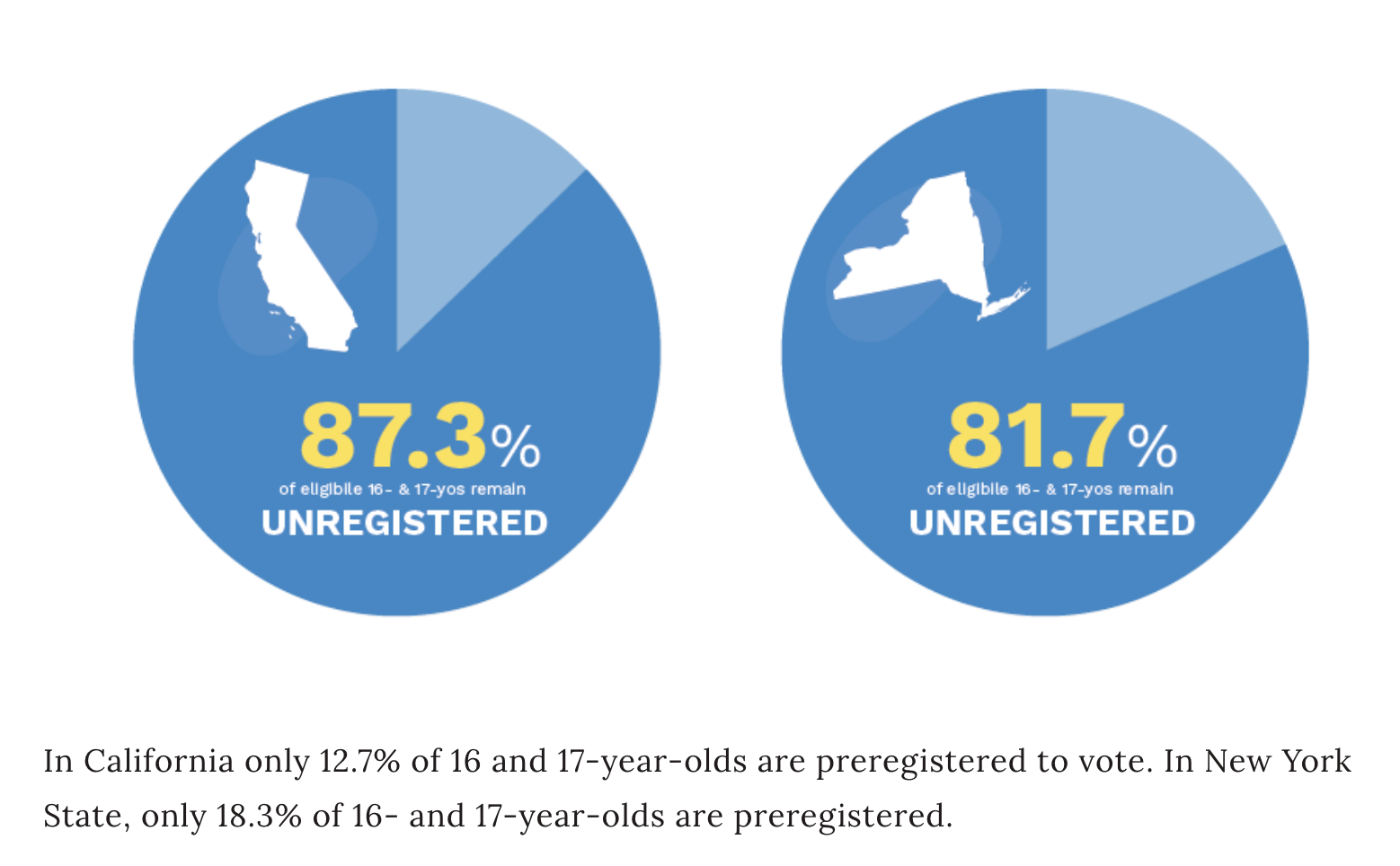
Now take California and New York, states that both allow pre-registration at 16. Together, they have over 1.25 million 16- and 17-year-olds who could be pre-registered right now.
- But in California, only 12.7% are pre-registered. In New York, it’s 18.3%.
- In their most populous counties, the rates are worse: In Los Angeles and San Diego the rates range from 10.9% to 14.3%. The most populous counties in New York (New York, Kings, and Queens) have rates below 5%. (Source: The Civics Center)
 |