CEO Update: The youth-vote myth that pundits still get wrong


Across 2024, there was a steady stream of commentary insisting young voters were “shifting to the right.” Even at the time, the data didn’t support that. My read of the data pointed to a collapse in participation, not an ideological realignment. Now, just weeks after the 2025 elections, we have fresh results that reinforce my assessment and show, again, that young people remain a powerful voting bloc.
The November elections made this plain.
In both Virginia and New Jersey, the AP/SSRS Voter Poll found that voters under 30 broke hard for the winning gubernatorial candidates. Roughly eight in ten young women and about six in ten young men backed the winning Democrat in each state. Turnout gains made a decisive difference: in New Jersey, 29% of young voters cast a ballot, up nine points from 2021; in Virginia, youth turnout climbed to 34%, a seven-point increase. In races dominated by cost-of-living concerns and limited media attention, those few points separated headlines from governing power.
In New York City, youth participation rose sharply. 19% of young voters cast ballots, up eleven points from 2013 (Tufts Circle points out that there’s no youth–turnout data for the 2021 NYC mayor’s race, but overall turnout was only 23%, so youth turnout was almost certainly even lower). In 2025, Gen Z and Millennials delivered a forty-plus point margin for the mayor-elect, enough to offset a ten-point deficit among voters aged forty-five and older.
Meanwhile, in California, Proposition 50 drew overwhelming support from young voters, with surveys showing approximately 84% of 18 to 24 year olds and 76% of 25 to 29 year olds in favor.
And these votes don’t come easy.
Days before Virginia voted, the NAACP had to sue over student registrations tossed for dorm/mailbox details, exactly the kind of technical barrier that sidelines first-time voters. In Maine, a voter-ID referendum (defeated) would have excluded student IDs and squeezed absentee access.
So why did so many pundits misread the trend in 2024?
Because when you look only at vote share, you erase the largest group in American politics: the non-voters, which remained home and on the couch. In 2024, the Couch “won.” That is bad news for democracy, but not proof of a youth realignment.
Below is the chart that’s been making the rounds showing a 6-point swing to the right among young voters. It is incomplete at best and misleading at worst. By focusing on “vote share,” it sidesteps the non-voters entirely. So, great for hot takes. Useless for actual planning.
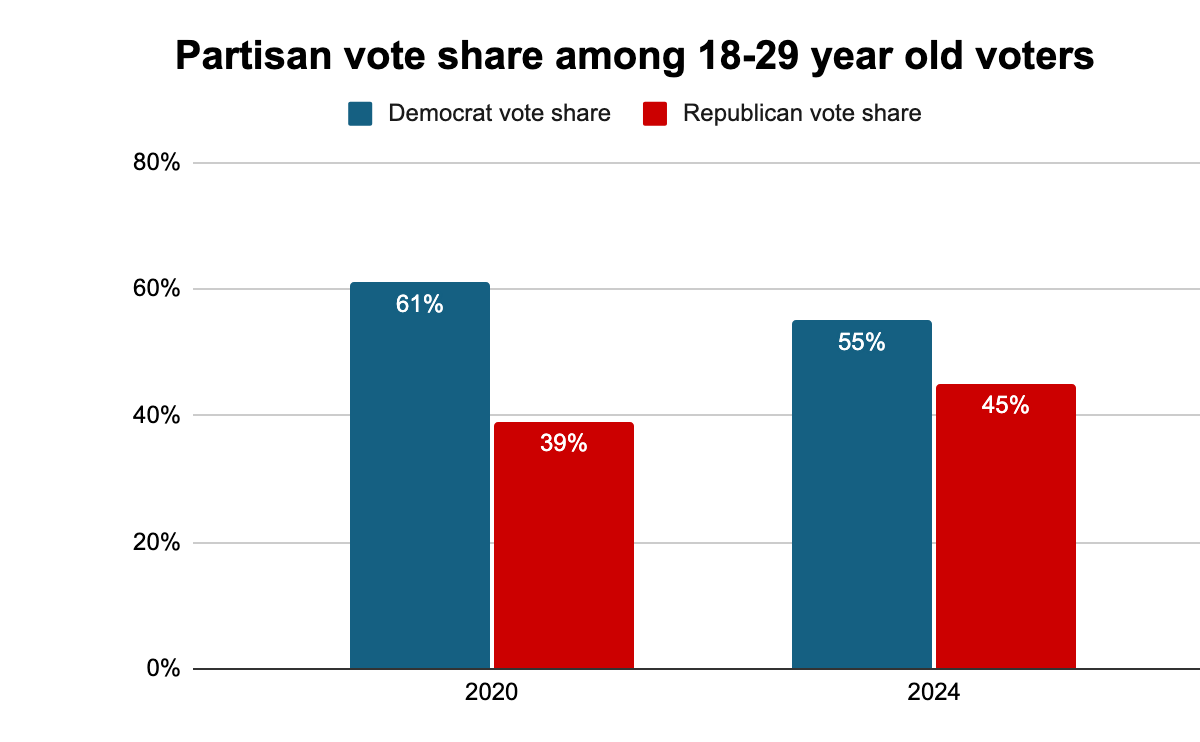
The real story is straightforward: in 2024, young voters didn’t move right. They just didn’t show up.
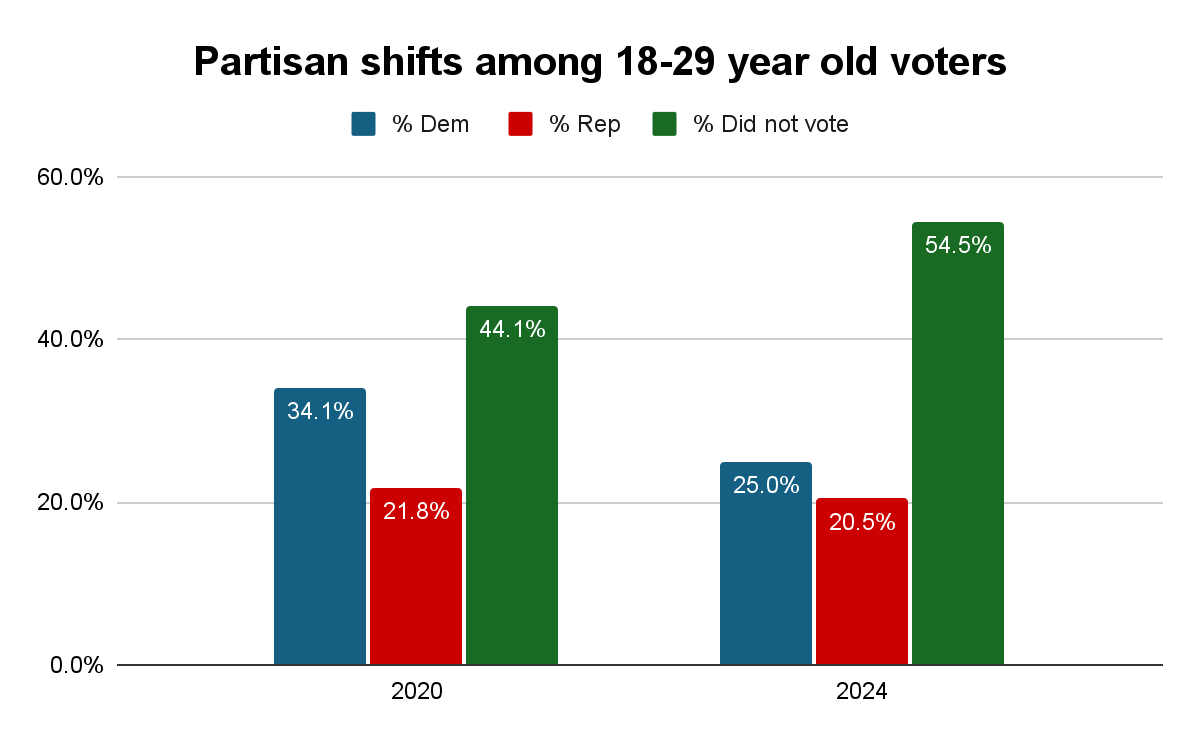
When you consider the entire citizen voting-age population (CVAP), that rightward narrative evaporates. Almost 55% of young people did not vote, up from 44% in 2020. The major movement was away from participation at all.
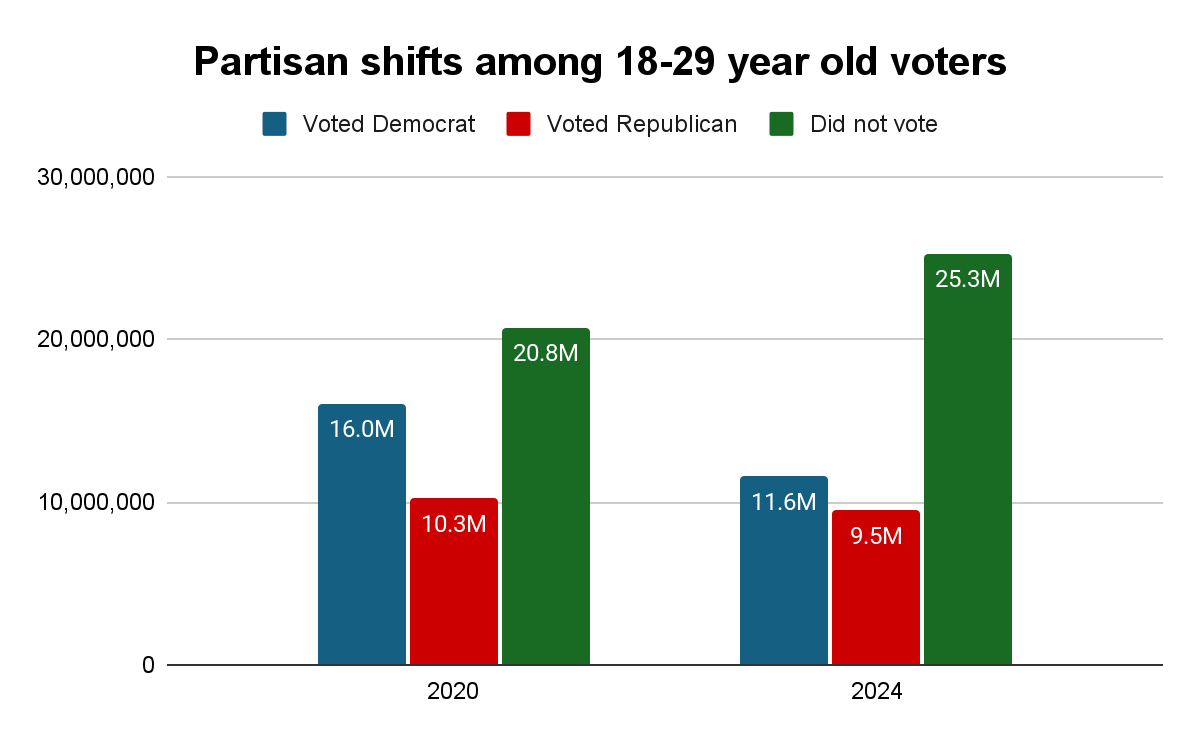
Raw votes make this even clearer. Democrats received approximately 4.8 million fewer youth votes in 2024; Republicans lost roughly 800,000. Those “lost” Democratic youth did not become Republican voters. They became non-voters. We need to recognize that there’s another party at play: the Democrats, the Republicans, and the Couch. In 2024 the couch was winning.
For what it’s worth, across credible polling, young voters who did vote were more supportive of Kamala Harris.
Writing off young people means writing off the future.
That’s why we’re investing in pre-registration.
- It works. Research shows youth pre-registration increases youth turnout, and that those gains persist. When done during high-salience election cycles, the impact on turnout is even larger.
- The window is huge. ~4–4.4M Americans turn 18 in a typical year (that’s one full cohort for the 2026 midterms). By 2028, 12M students sitting in today’s high schools will be eligible if we capture them now.
- The pipes exist, but flow is a trickle. Pre-registration is available in 49 states + D.C., but only few eligible teens are pre-registered. Just 11 states encourage/require high-school registration.
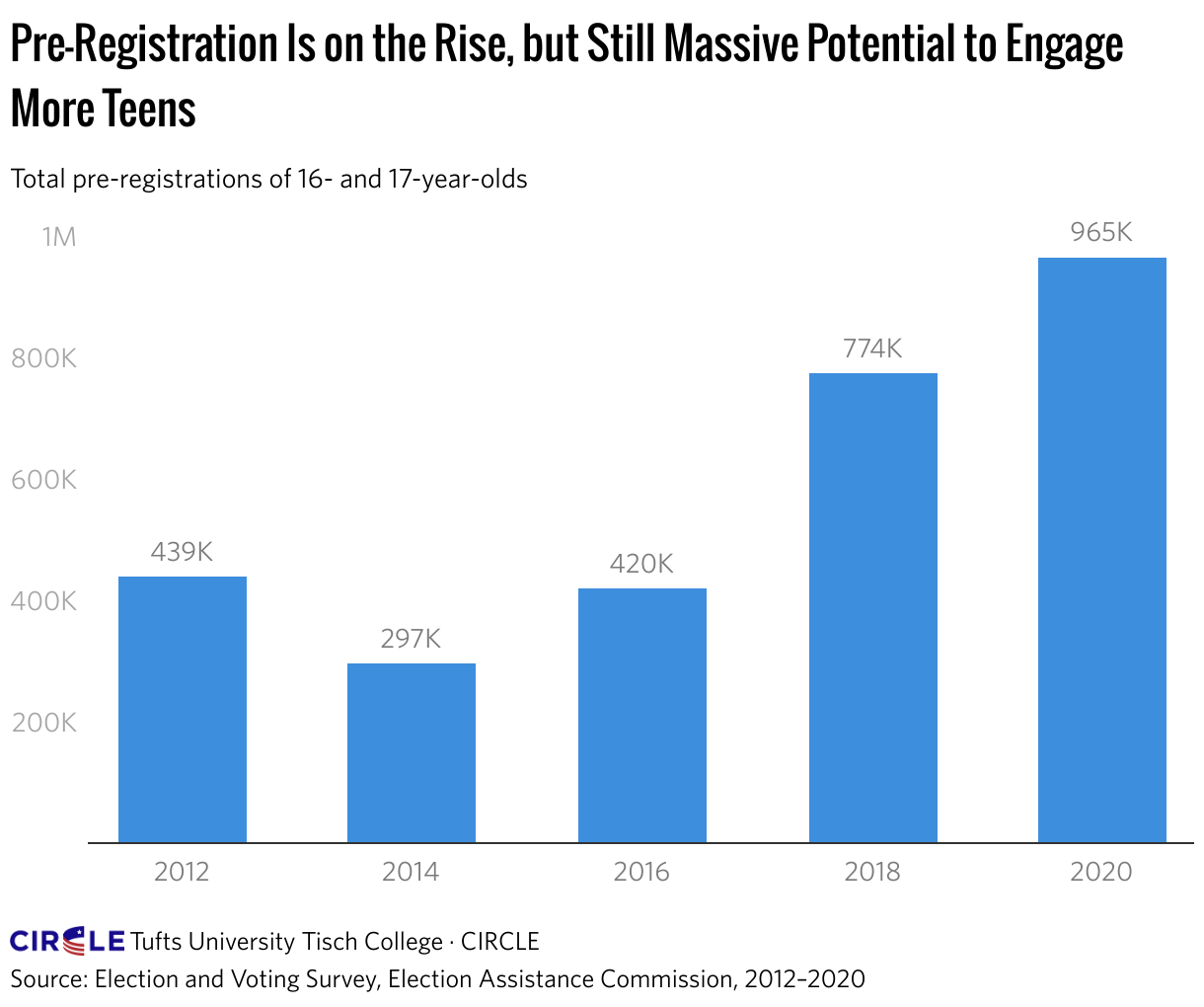
We reject the idea that young people need to be convinced to vote. They need to be able to vote.
Our solution: FutureVoter (VoteAmerica)
FutureVoter is a persistent, one-to-many pre-registration system that meets teens where they already are, like applying to college or filling out teen banking forms. We pre-register young people based on the rules of their state, and then nudge them (birthday-timed) through the first ballot. We standardize 50-state rules into a single, simple flow. It’s live, and deeper integrations are queued.
Ultimately, voting is habit-forming. The age of first vote predicts lifetime participation. FutureVoter locks in that first vote so campaigns aren’t scrambling to find 18-year-olds every two years.
This quarter, thanks to a wonderfully generous matching challenge from the Jacobs Family Foundation, and an outpouring of support from all of you, we raised $400,000! We’re beyond grateful. But to bring this home, we still need to fully underwrite the work, including:
- Platform integrations, automated reminders through 18th birthdays, and state-by-state compliance — reaching millions of teens where they already are online.
- Core infrastructure to keep the tool accurate, embeddable, and fast in all 50 states.
- Rigorous research, academic partnerships, and evaluation to measure impact.
- Efforts to engage students and parents and build a durable community around participation.
Why this matters now
- 2026: We can capture ~one full cohort (~4M) of new voters before their first eligible election
- 2028: With ~12M future voters in today’s high schools, scaled pre-registration is the surest way to convert youth energy into ballots in the next presidential cycle.
- Policy + practice amplifies results: States with youth-friendly registration policies (including pre-reg) see measurable turnout gains.
Together, we can help FutureVoter secure hundreds of thousands of verified teen registrations ahead of 2026 — and lay the foundation for millions by 2028.