CEO Update: Voter registration does not increase turnout, here's what does.

Debra Cleaver

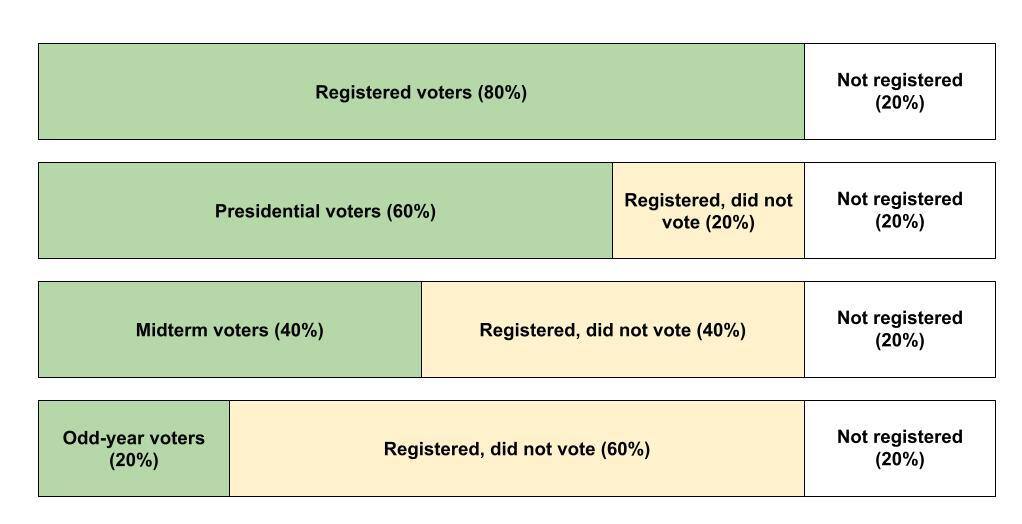
This email, like all of my emails, is too long, so I'm not going to bury the lede. The US doesn't have a voter registration problem, we have a voter turnout problem. 80% of Americans are already registered to vote, but only 60% of voting aged citizens cast ballots in a presidential election year. If we can get registered voters to cast ballots, we can increase turnout by 20 points. The absolute best run voter registration drives produce less than a 1 point boost in turnout during a presidential election year. I'm not saying that you shouldn't spend any money on voter registration: I'm saying that you should understand, before you write those checks, exactly what the return on your investment is. And then consider making those investments only in the handful of states where 1 point might actually deliver a margin of victory.
Here are some other stats for you:
|
 |
Given the above, almost all of VoteAmerica's efforts in 2024 will go to increasing turnout among registered voters. We spent a few months reading every RCT we could find on turnout tactics, and concluded that very few of them produce more than a 1 point boost in turnout. That's just not enough of a return on investment for me to justify the 100 hour week I tend to work during a presidential year, or the millions of dollars I spend.
So what does actually work to increase turnout? Voting by mail. People who receive their ballots at home are significantly more likely to actually vote than those who vote in person.
In my last email I mentioned the VoteAmerica Research Center and Professor Scott Minkoff’s observational analysis on the impact of universal vote by mail (UVBM) and permanent absentee voting (PAV) on voter turnout. In the first category of states, anyone can vote by mail but you need to request a ballot for each election. In the permanent absentee voting states, you sign up once and receive a ballot in the mail automatically for all future elections. We then looked at the difference in turnout rates within PAV states between registered voters who signed up for PAV and those who had to vote in person. The difference in turnout was shocking.
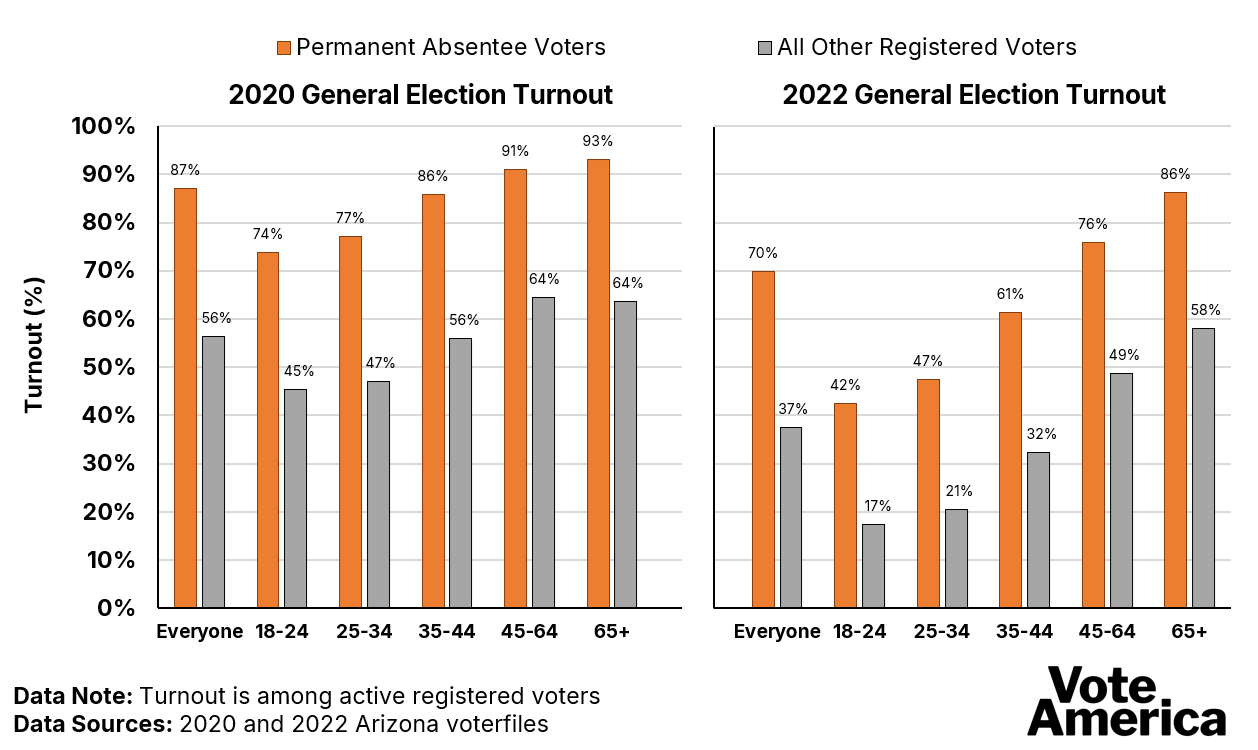
The graphs below show turnout rates in Arizona between permanent absentee voters and other registered voters. In 2020 and 2022, there is over a 30-point difference in turnout rates, with the largest boost being seen with the youngest voters. |
 |
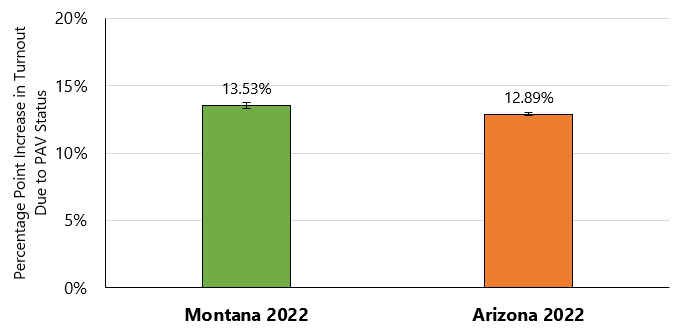
While the turnout comparisons have the luxury of being very straightforward, we recognized that they lack the ability to control for multiple variables simultaneously. So we ran turnout regression models controlling for county turnout, voter propensity, age, marital status, gender, and race/ethnicity. The regression analyses indicate that the average turnout lift from PAV status was 13.53 percentage points for Montana and 12.89 percentage points for Arizona. |
 |
Why does vote by mail increase turnout? Because this method of voting cuts through the red tape and brings the ballot box directly to the voter. Convenience, not enthusiasm, influences turnout.
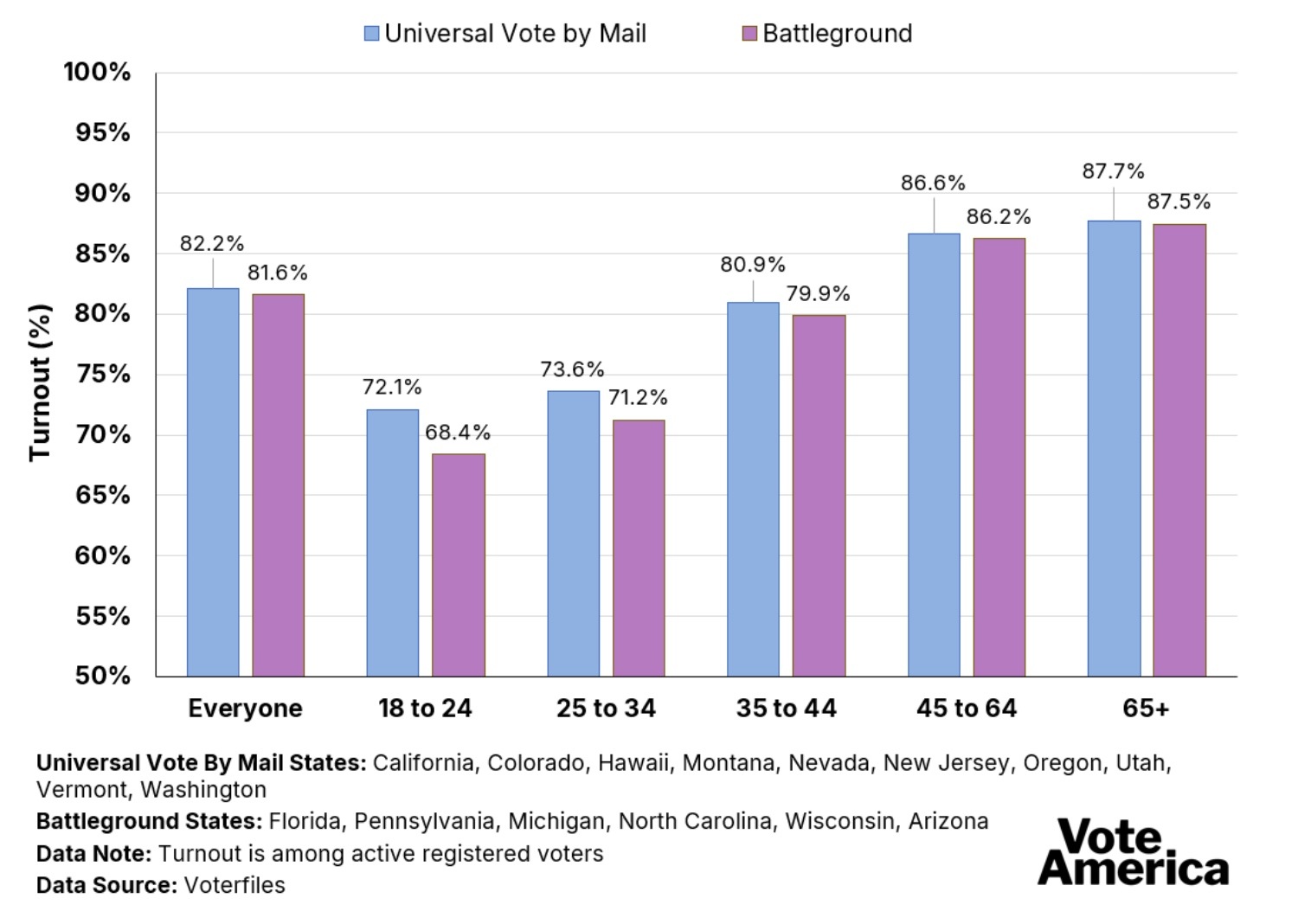
Here's another way of looking at this. In 2020 there were 10 states that held their elections by mail, meaning that 100% of registered voters received their ballot in the mail (this is called universal vote-by-mail, or UVBM). We're talking California, Colorado, Hawaii, Montana, Nevada, New Jersey, Oregon, Utah, Vermont, Washington. Most of these were not competitive states. No one was spending money to turn these voters out. But turnout in UVBM states was 0.6 percentage points higher than turnout in battleground states, where battleground states are defined as those where partisan groups spent at least $90 million on broadcast TV. Turnout in UVBM states was higher across all age cohorts. Notably, turnout among younger voters (18 to 24) in UVBM states was about 3.7 percentage points higher than in battleground states. No amount of partisan spending provides as a big a turnout lift as simply receiving your ballot in the mail. |
 |
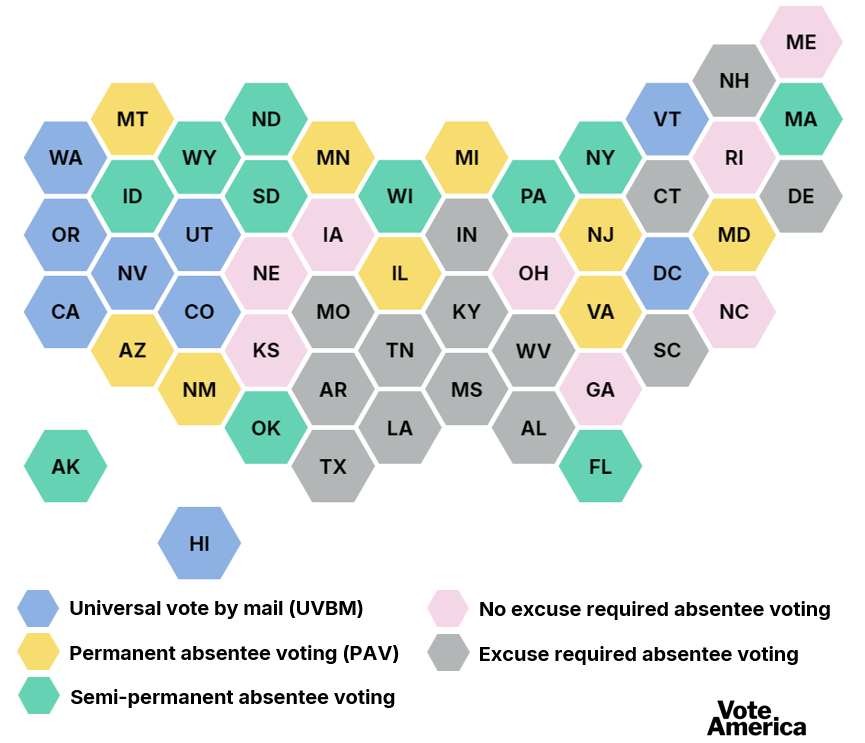
So here's the 2024 plan. In partnership with our friends at the National Vote At Home Institute, the VoteAmerica team is going to focus on recruiting registered voters to vote by mail. Because we are not blessed with unlimited funds, our currently plan is to focus on states that offer permanent absentee voting (PAV), which means you sign up once and you receive your ballots in the mail in perpetuity. There are 9 states that offer PAV, and we’re going to start there (Arizona, Illinois, Maryland, Michigan, Minnesota, Montana, New Jersey, New Mexico, and Virginia). Then we’ll move on to the 15 states that offer no-excuse absentee voting.
|
 |
The 2020 margin of victory in Arizona was just 0.30%, in Michigan it was 2.80%. With the potential to increase turnout 13 percentage points, vote by mail programs could be the deciding factor this year. |