CEO Update: We need to buy billboards. ASAP.

Debra Cleaver

Shocking no one, I’ve penned a pretty lengthy email below. It’s time sensitive and important, so I hope you make it to the end. Bottom line upfront: billboards can get millions of voters to the polls. They’re highly affordable, and they scale. The deadline for us to buy physical billboard inventory in competitive states is September 6th. We’ve raised ~$2.75M which is a great start, but we can go much much bigger.
You’ve probably heard me say at least once that if carrier pigeons were the best way to get the word out about voting, I’d be in the pigeon business. Fortunately for me (and the VoteAmerica team, who almost certainly does not want to train birds for a living), that’s not the case. Here’s what is:
Billboards. They are one of the most scalable ways to get Americans out to the polls. It feels so obvious, it almost seems too good to be true.
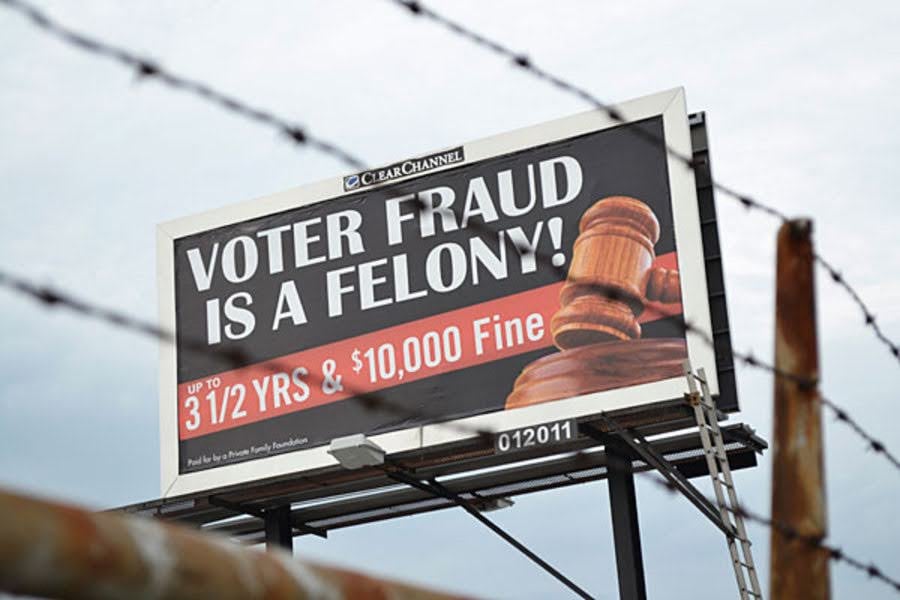
I got into billboards because I saw that they were, unfortunately, an extremely effective (and extremely cheap) voter suppression tactic. My theory was that if billboards could be used to keep voters away from the polls, they could be equally impactful at driving voters to the polls. Since then, I’ve personally led some of the largest billboard mobilization campaigns in the country. And this year, we’re going bigger than ever.
Here’s what a voter suppression billboard looks like: |
 |
Here’s what a VoteAmerica billboard looks like: |
.jpg?upscale=true&width=10950&upscale=true&name=VA%20-%20Billboards%20-%2005_12x18_color%20(5).jpg) |
Billboards work because they solve for two of the biggest barriers to voting:
As the Analyst Institute has advised in the past, the single most accurate predictor of whether or not you vote is whether you know the date of the election.
So that’s the gist: in order to overcome voter suppression and other barriers to voting, voters simply need the basic facts delivered to them in a clear, direct, and easy-to-digest format. This is the basic formula to all of the voter mobilization programs I run. In fact, in 2017 my billboard program was so well received that it was literally mistaken for government PSAs.
It gets better, though. I’ve learned that when you layer billboard campaigns with other tactics, like digital ads, radio, SMS campaigns and even on-the-ground efforts, they become even more impactful. Years of marketing research supports this: multi-channel outreach is better than single-channel outreach.
Here’s something else that seems obvious: billboards have a much longer shelf life than other mobilization tactics. We book billboard inventory for 4 weeks at a time and we make sure to fully saturate an area, meaning we’re not just putting up 1 billboard but we’re buying up as many as possible. Our billboards are constant and unavoidable long-term advertisements. They reach voters multiple times, and they stick. (Billboard recall is nearly 50% and increases with higher reach and frequency in your campaign).
If I haven’t convinced you yet, I know this will: billboards are not only an effective way to get voters to the polls, they’re also shockingly inexpensive. This year, the average billboard is under $8,000 for a 4-week run. Low production costs combined with high CPMs (cost per 1000 views) make billboards and outdoor advertising one of the most affordable advertising channels available. Our previous studies have shown that OOH increases turnout at a cost of about $100 per net new vote.
Because inventory is cheap, voter suppression groups buy up as much as they can as quickly as they can, while pro-democracy efforts almost ignore the tactic completely. Don’t ask me why so much of partisan outreach dollars are still spent on broadcast TV ads when 47% of adults 22-45 are watching absolutely no content whatsoever on broadcast TV. Investing in billboards has the enormous advantage of making up for where partisan efforts are falling short.
I imagine that this week your inbox is full of emails talking about the programs people are running for this election, especially the field programs. Nothing will ever replace on-the-ground programs, but face-to-face conversations are expensive and difficult to scale. I think we can all agree that right now we need to reach as many voters as possible, including the low- and mid-propensity voters often overlooked by partisan campaigns. We can — and must — secure billboards right now to ensure that as many voters as possible have the information they need to vote this November, including those we won’t reach through face-to-face outreach.
|
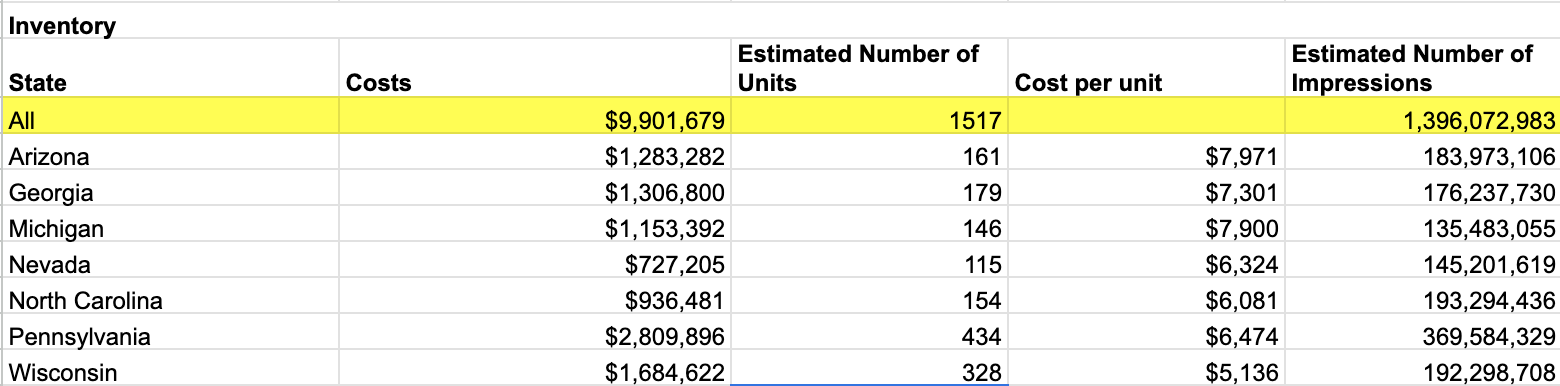 |
Like I said at the beginning of this email, we only have until September 6th to book this inventory. We’ve raised ~$2.75M which is a great start, but we can go much much bigger. |